Most aircraft flying in controlled airspace today broadcast their position, altitude, speed, and identity about twice per second on an open radio frequency. This system is called ADS-B (Automatic Dependent Surveillance-Broadcast), and it's the backbone of modern air traffic control - and the primary technology behind virtually every flight tracking app and website you've ever used.
What ADS-B Stands For
Automatic
Requires no pilot input or external interrogation. The system broadcasts continuously on its own.
Dependent
Relies on the aircraft's onboard GPS receiver for position data, rather than ground-based radar.
Surveillance
Provides real-time tracking information to air traffic control and other aircraft.
Broadcast
Transmits openly on 1090 MHz. Unlike radar, anyone with a receiver can pick up the signal.
That last part - broadcast - is what makes ADS-B so interesting for aviation enthusiasts. Unlike traditional radar, which requires expensive ground stations to interrogate aircraft transponders, ADS-B signals are transmitted openly. Anyone with an inexpensive radio receiver can pick them up.
How ADS-B Works
An ADS-B-equipped aircraft has a GPS receiver and a transponder. The GPS determines the aircraft's precise position, and the transponder broadcasts that position - along with other flight data - on 1090 MHz Extended Squitter (1090ES). These broadcasts happen automatically, typically once or twice per second.
In the US, aircraft flying below 18,000 feet can alternatively use 978 MHz UAT (Universal Access Transceiver) instead of 1090ES - common among general aviation aircraft. Most receivers can handle both frequencies.
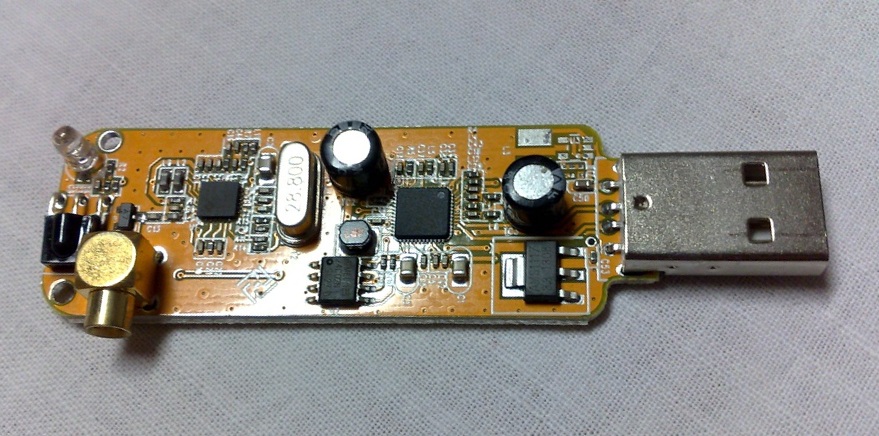
On the ground, ADS-B receivers pick up these transmissions. Air traffic control uses networks of certified ground stations, but the same signals can be received by anyone with a software-defined radio (SDR) dongle - a USB device that costs as little as $25.
What data does ADS-B broadcast?
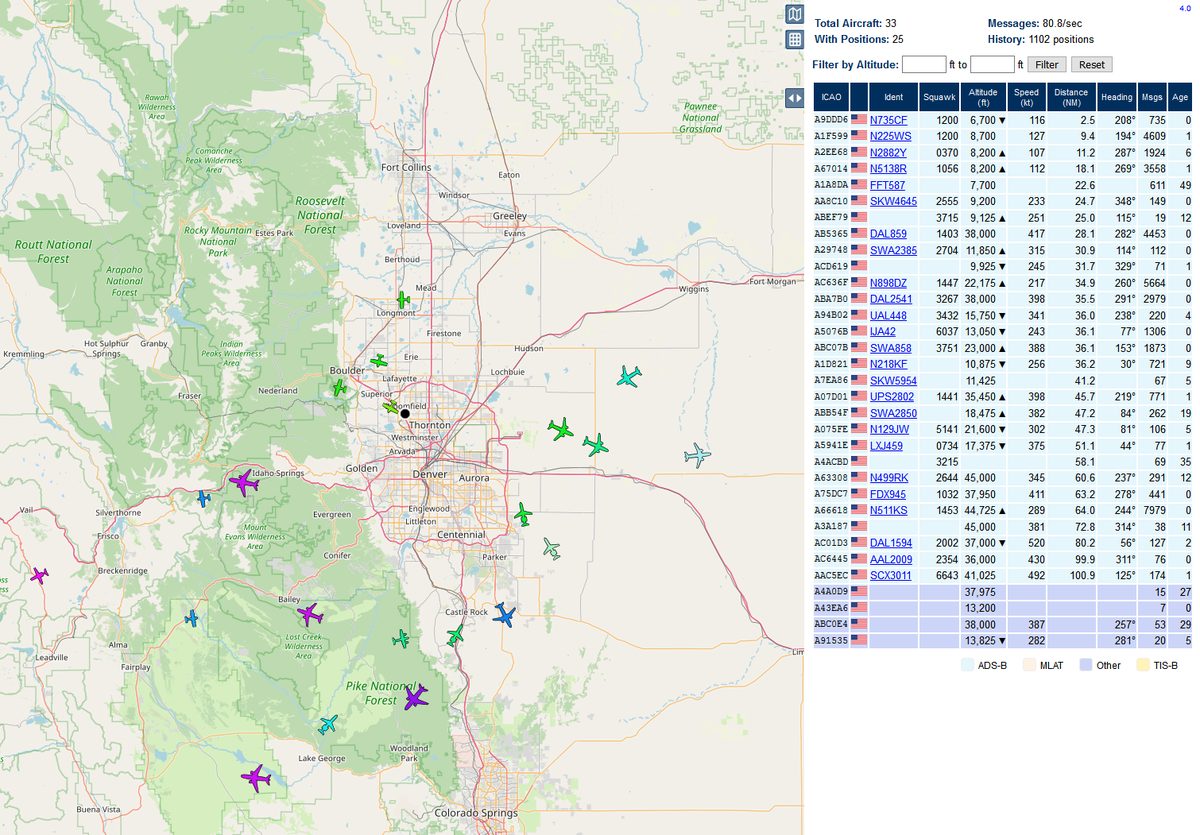
Each ADS-B message contains some or all of the following:
- - ICAO hex address - a unique 6-character identifier for the aircraft (e.g., A0B1C2)
- - Position - GPS latitude and longitude
- - Altitude - barometric pressure altitude and/or geometric (GPS) altitude
- - Ground speed and heading - how fast and in which direction
- - Vertical rate - climbing, descending, or level
- - Callsign - the flight's radio callsign (e.g., UAL1234)
- - Squawk code - the transponder code assigned by ATC
From the ICAO hex address, you can look up the aircraft's registration (tail number), type (Boeing 737, Airbus A320, etc.), and owner. This is how flight tracking services connect a stream of anonymous radio messages to "United Flight 1234, a Boeing 737-800 flying from Denver to Chicago."
ADS-B Out vs. ADS-B In
ADS-B Out
The transmitting side. Aircraft broadcast their position and flight data. ADS-B Out has been mandatory for most aircraft operating in controlled airspace in the US since January 2020 (FAA rule 14 CFR 91.225), and in Europe under the EASA mandate.
ADS-B In
The receiving side. Aircraft equipped with ADS-B In can receive broadcasts from other aircraft, giving pilots situational awareness of nearby traffic - essentially a traffic display in the cockpit. It's not yet mandatory.
When people talk about "ADS-B tracking" for plane spotting, they're referring to receiving ADS-B Out transmissions on the ground. Your receiver is doing the same thing as an aircraft with ADS-B In - just from a fixed location instead of the air.
Community ADS-B Networks
A single ADS-B receiver on the ground can typically pick up aircraft within a 200-300 nautical mile radius, depending on antenna placement and line of sight. But to build a complete picture of global air traffic, you need thousands of receivers working together.
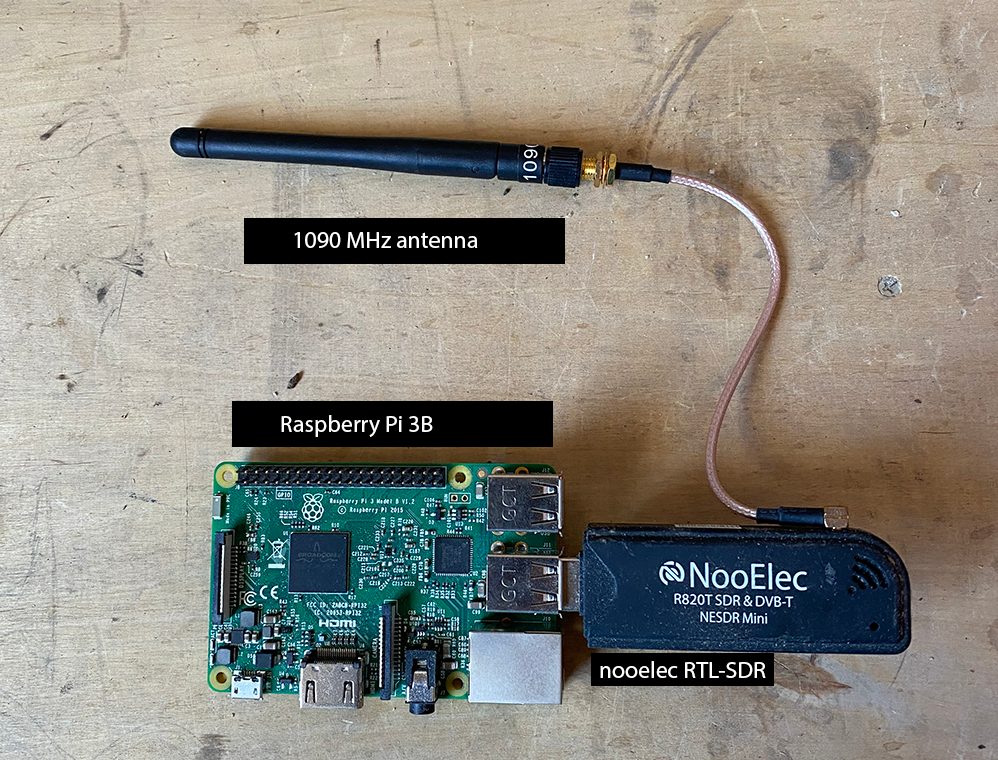
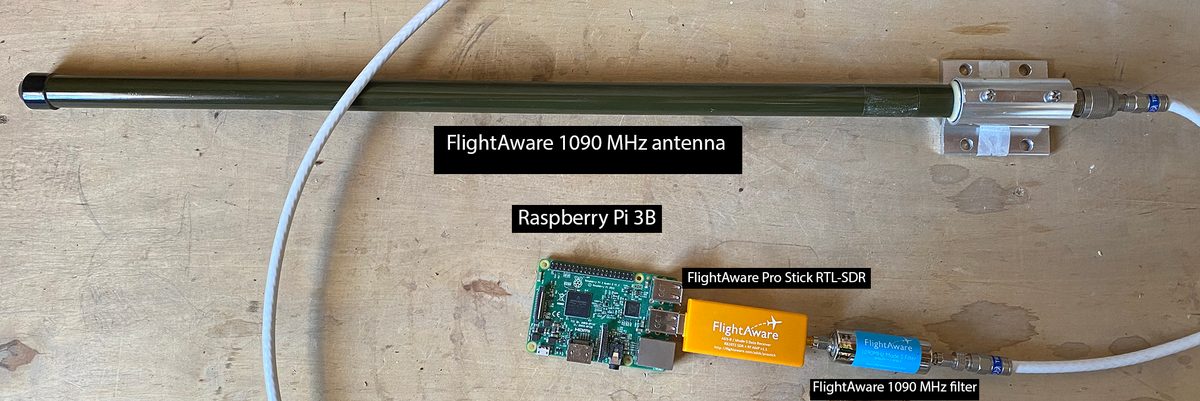
This is exactly what community feeder networks do. Volunteers around the world run ADS-B receivers and share their data with aggregation services. The major networks include:
- adsb.lol - open-source, community-run aggregator with no data restrictions
- ADS-B Exchange - one of the largest unfiltered feeds, popular with enthusiasts
- FlightRadar24 and FlightAware - commercial services that combine ADS-B with other data sources
SkySpottr uses aggregated ADS-B data from these community networks to provide real-time aircraft positions. When you point your phone at the sky, the aircraft positions you see are derived from ADS-B broadcasts being received by feeders potentially hundreds of miles away - relayed to our servers and then to your device over a WebSocket connection updated twice per second.
Why ADS-B Changed Plane Spotting

Before ADS-B, identifying aircraft required expensive radio scanners, memorizing airline liveries, or simply guessing. You'd see a contrail at 35,000 feet and have no way of knowing if it was a 737 or an A380.
ADS-B changed that completely. Now, with a cheap receiver or a phone app, you can identify every aircraft in the sky around you - its type, airline, route, altitude, speed, and where it's coming from and going to. The data is free, real-time, and remarkably detailed.

The challenge is making that data useful in the moment. A map on a screen is helpful, but when you're standing outside looking up, you want to know which data goes with which plane. That's where augmented reality tracking comes in - and it's why more people are getting into plane spotting than ever before.
See ADS-B Data in Augmented Reality
SkySpottr takes live ADS-B data and overlays it directly on your camera feed. Point your phone at a plane overhead and instantly see its flight number, type, altitude, speed, and destination - no guessing, no map-matching required.